

Top Water Jet Sewer Machine Manufacturer in China for Reliable Sewer Cleaning Equipment
2026-10-20
When municipal crews and contractors face clogged lines, they don’t just need a water jet sewer machine—they need one that starts fast, clears stubborn debris, and holds up shift after shift. That’s exactly the reputation AMJET has built among top sewer equipment manufacturers in China. In this post, we’ll look at what makes their machines a dependable choice for everything from routine maintenance to emergency blockages.
How a 500-Bar Pump Turns Stubborn Sewer Blockages into Clear Lines
At 500 bar, the pump doesn't just push water—it drives it with enough force to shear through grease, roots, and compacted debris. The narrow jet nozzle turns that pressure into a cutting stream, slicing blockages apart layer by layer rather than simply nudging them downstream.
What makes this pressure level effective is that it hits the blockage before water has a chance to spread out. The energy stays concentrated, so even hardened scale or years of fat buildup come loose in minutes. Operators often hear a distinct change in pitch as the jet bites through the last plug.
Yet the real trick isn't brute force alone. The pump pulses slightly, letting water backwash and carry loosened material away. That stop-start rhythm prevents the line from simply re-clogging a few meters further on—clearing the pipe, not just relocating the problem.
Inside the Production Floor Where Every Machine Gets a Wet Test Before It Leaves
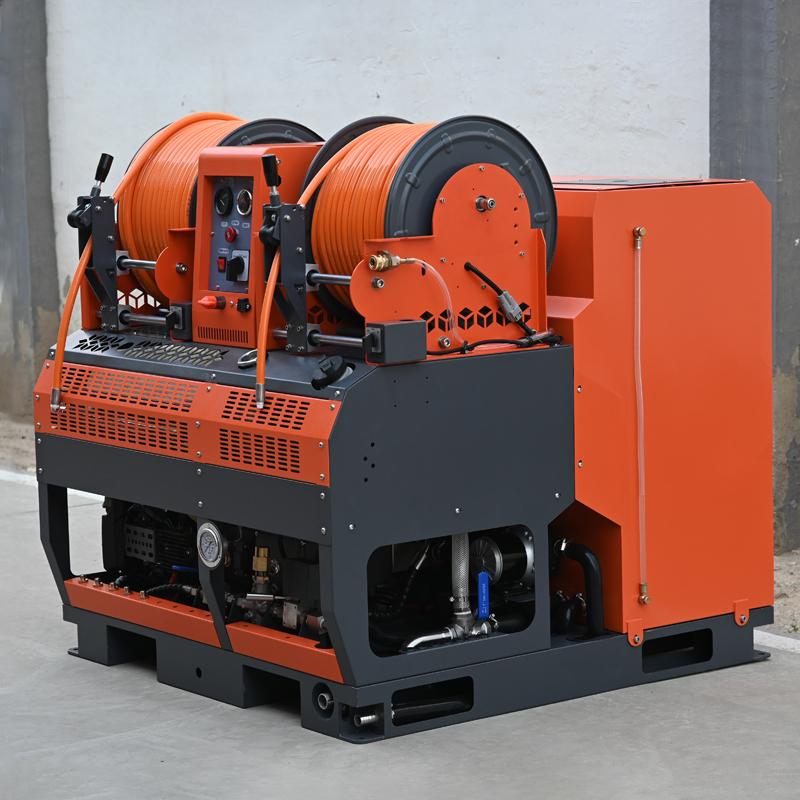
Walk onto the production floor and you'll notice something unusual: rows of finished machines connected to water lines, running full cycles before they ever get crated. It's not a quick splash or a visual once-over. Every unit goes through a wet test that mimics real-world use, from cold starts to sustained high-pressure runs. Technicians watch gauges, listen for irregular vibrations, and check for the smallest drips that might only appear under load.
The wet test isn't just about catching leaks. It's a final proof that seals, valves, and internal plumbing hold up when the machine actually works. A unit might pass every dry inspection on the bench, but introduce water, heat, and pressure, and suddenly a slightly misaligned fitting reveals itself. By running each machine through its paces here, the team catches issues before they become a customer's emergency call.
What sets this floor apart is the refusal to skip the test even when orders pile up. The schedule bends, but the wet test doesn't. That consistency has built a reputation for machines that arrive ready to run, not merely assembled. It's slower, yes, but the alternative costs far more in the field.
Why Operators Prefer These Truck-Mounted Units for Emergency Call-Outs
When a call comes in at 3 a.m. and every minute counts, the last thing an operator wants is a unit that needs coaxing to start or a setup sequence that eats into response time. These truck-mounted units have earned their place in emergency fleets because they are ready to roll the moment the key turns. The hydraulic systems are pre-primed, the controls are within arm's reach from the driver's seat, and there is no need to unhitch or level anything before getting to work. Compare that to a trailer-based setup that requires backing into tight spots and dropping stabilizers, and it is easy to see why operators who have run both would never go back.
Beyond the initial response, emergency call-outs often mean working in unpredictable conditions—muddy shoulders, narrow alleys, or sites with zero room for error. Truck-mounted units put the operator in a familiar cab with better visibility and traction than a towed rig. The weight distribution is also a factor: a properly spec'd chassis handles the load without porpoising on rough roads, which keeps the equipment stable and the driver in control. Operators who have spent a night bouncing between calls appreciate that the unit feels like part of the truck, not an afterthought strapped to the back.
There is also the matter of fatigue. Emergency work often means long stretches with no downtime, and a unit that requires fewer steps to deploy and stow saves both physical and mental energy. The controls are laid out so that one person can run the entire operation without walking around the vehicle or fumbling with remote pendants in the dark. That may sound like a small detail, but after the tenth call-out of a storm season, those saved minutes and fewer moving parts are exactly what keep operators sharp and the unit ready for the next call.
The Ceramic Nozzle Upgrade That Extends Service Life in Gritty Conditions
Standard steel nozzles wear down fast when abrasive particles are constantly blasting through. The switch to a ceramic insert changes that equation. It's not just a harder surface—it's a different wear pattern. Instead of gradual erosion at the throat, you see almost no measurable loss after hundreds of hours in dirty airstreams.
What makes this upgrade practical is the press-fit design. No adhesives, no special tools. The ceramic collar drops into the existing housing and locks against the shoulder. Even in high-vibration setups, it stays put. Teams report swapping nozzles half as often, which means fewer shutdowns and less fiddling with alignment mid-run.
For operations running fine grit, recycled abrasive, or dusty outdoor air, the payback is immediate. You get consistent spray patterns longer, and the nozzle throat doesn't oval out. That directly translates to less overspray, tighter tolerances, and a maintenance schedule that finally matches the rest of the equipment.
Matching Water Flow and Pressure to Pipe Diameter Without Guesswork
Choosing a pipe diameter based on a hunch leads to either starved fixtures or money wasted on oversized lines. A better starting point is to pin down two numbers before touching a fitting: the flow rate you actually need in gallons or liters per minute, and the pressure available at the supply while water is moving. Static pressure tells you almost nothing—once flow starts, friction along the pipe wall eats into that pressure. For turbulent flow, pressure drop rises sharply as diameter shrinks, roughly with the inverse fifth power of the internal diameter. That means going from a 1/2-inch to a 3/4-inch pipe can cut friction loss dramatically, not by a small percentage.
Once you have those two figures, use a pressure drop chart or the Hazen-Williams equation instead of guessing. Aim for a flow velocity between 1.5 and 2.5 meters per second—fast enough to keep sediment from settling, slow enough to avoid water hammer and loud hissing. Then add the equivalent length of every elbow, tee, and valve to the straight pipe run. A single globe valve can add the resistance of several meters of straight pipe, which many DIY plans ignore until the sprinklers wheeze at the far end of the garden.
After installation, don’t declare victory on paper. Open the farthest outlet and measure dynamic pressure there with a gauge while other fixtures run at the same time. If the pressure is below what the appliance or shower head needs, the fix is usually a larger main branch, not a bigger pump. Conversely, if you have plenty of pressure and low flow, a smaller diameter may actually improve heat retention in hot water lines and cut material cost. The goal is a system where the pipe diameter matches the real demand, not one that works only when everything else is turned off.
What a 10,000-Hour Duty Cycle Means for Cities With Aging Sewer Networks
A 10,000-hour duty cycle is less about a hard expiry date and more about accumulated stress. For a lift station pump that runs intermittently, those hours can stretch across five to seven years, depending on how often wet weather forces it into action. In older sewer networks, this benchmark often arrives sooner than expected because inflow and infiltration add unplanned run time, and the pumps were never sized for that sustained load. What looks like a comfortable buffer on paper disappears quickly once cracks let groundwater in.
That mismatch becomes visible when components near the 10,000-hour mark start failing in clusters. Bearings wear unevenly, seals dry out, and impellers lose efficiency right when storm events demand peak output. Cities with aging pipes rarely have clean run-time logs, so they may not realize a pump has crossed the threshold until a wet well overflows. The duty cycle, then, is not just a maintenance interval; it is a signal that the surrounding network has changed the pump's actual operating profile.
Using the 10,000-hour figure as a planning yardstick can shift repair budgets from emergency response to scheduled replacement. Even approximate run-time data from SCADA systems helps identify pumps that are silently running beyond their design assumption. For an aging sewer network, that small shift in attention prevents the most common failure mode: not the dramatic collapse, but the slow accumulation of hours that nobody thought to count.
FAQ
Look at the pump's pressure and flow balance, not just the horsepower. A solid unit pairs a high-torque diesel engine with a triplex plunger pump that holds steady pressure without pulsing. Pay attention to the nozzle set too—interchangeable fronts with different spray angles make a huge difference when you're switching from grease to root-filled lines.
It's all about sustained flow. Instead of relying on short bursts, a well-designed jetter pushes 40 to 80 gallons per minute at 2,500 to 4,000 psi through a root-cutting nozzle. That combination carves through blockages without chewing up the pipe wall. Some builders also include a hydraulic hose reel that maintains tension, so the nozzle keeps advancing instead of getting stuck.
Ask for documented pump test curves and a full-component list. Reputable shops will show you the brand of engine, pump, and controls—not just a generic 'high quality' claim. Check if the frame is hot-dip galvanized and whether the control panel is rated for wet environments. A factory that does its own pressure testing, with video proof, is worth more than a stack of certificates.
Most top-tier manufacturers offer modular layouts. You can specify the reel location, hose length, tank capacity, and even the side of the controls. If your crew is used to a certain workflow, a good builder will adjust the plumbing and valve placement rather than forcing you to adapt to a one-size-fits-all frame.
Flush the pump with clean water after every shift if you've been using recycled water. Check nozzle orifices weekly—worn or clogged tips reduce pressure and waste fuel. Change hydraulic filters on schedule, not when they look dirty. Keep a spare set of high-pressure hoses and quick-connect fittings on the truck, because those fail before the pump ever will.
Reliable manufacturers usually assign an English-speaking engineer for video calls during setup and troubleshooting. Spare parts should arrive within a week if they keep a bonded warehouse in your region. Some will send a technician for on-site training for larger orders. Avoid builders that disappear after the final payment—ask for a written response-time commitment in the contract.
The upfront price is usually 30 to 40 percent lower, but the real savings come from part availability. Many Chinese factories use globally sourced pumps like Interpump or Udor, so you're not locked into proprietary spares. Labor costs for repairs are similar, but if the frame is well-protected against corrosion, you'll get an extra few years of service before rust becomes a problem.
A deadman switch at the nozzle end, a burst-proof hose sleeve, and a pressure relief valve that vents automatically if the line backs up. Look for a control panel that shuts down the pump if water temperature climbs too high. Some machines also include a two-man operation mode where the reel and the nozzle require separate confirmation, which prevents a lot of accidents.
Conclusion
Across China's heavy-duty cleaning sector, one manufacturer stands out for building water jet sewer machines that survive daily abuse. The core of every unit is a 500-bar pump engineered to clear years of grease, root mass, and mineral scale without stalling. Before any machine ships, it goes through a full wet test on the production floor—not a dry spin or a visual check, but actual water running through the jets at rated pressure. That step alone catches fitting leaks, valve lag, and nozzle alignment issues that would otherwise surface on a job site. The company also fits ceramic nozzles as standard, recognizing that gritty, sand-laden runoff eats through steel and carbide tips in a matter of months. By matching flow rate and pressure to specific pipe diameters, technicians avoid the common mistake of blasting small laterals with oversized force or underpowering large trunk sewers.
Field crews tend to favor these truck-mounted units for emergency call-outs because everything is ready to run the moment the truck stops—no separate trailer, no time lost coupling hoses. The build is rated for a 10,000-hour duty cycle, which matters for cities where aging sewer networks demand nonstop jetting season after season. Instead of replacing pumps or rebuilding hose reels every two years, municipal teams keep the same machine in rotation far longer. That durability, combined with the wet-test guarantee and ceramic component upgrades, explains why operators and fleet managers return to this manufacturer. Reliable sewer cleaning equipment is not about a single impressive spec; it is about predictable performance under real grit, real pressure, and real deadlines. This manufacturer delivers that balance.
Contact Us
Contact Person: Mike
Email: [email protected]
Tel/WhatsApp: +86 19545555505
Website: https://www.amjeting.com/