

Top 10 Dry Type Transformer Companies from China
2026-08-20
China’s dry type transformer industry has quietly become a global powerhouse, yet most buyers still rely on outdated shortlists. While names like ABB and Siemens dominate Western discussions, a new wave of Chinese manufacturers—including Wenma—is rewriting the rules on efficiency, safety, and cost. From smart grid upgrades to data center power systems, these companies are proving that dry type transformers no longer mean compromising on performance. Here’s the real ranking of the top 10 Chinese players you should be watching in 2025.
The Manufacturing Muscle Behind China's Dry Transformer Exports
Walk through any major industrial park in the Yangtze River Delta or the Pearl River Delta, and you will find entire clusters dedicated to transformer production. Hundreds of specialized workshops turn out core laminations, copper windings, and epoxy resin castings within a few kilometers of each other. This geographic concentration cuts logistics costs to almost nothing and lets manufacturers source custom parts overnight. The sheer scale of production runs—often tens of thousands of units per month from a single mid-size factory—means fixed costs get spread so thin that Chinese dry transformers routinely undercut Western rivals by 30 to 40 percent without sacrificing basic reliability.
Behind the low prices is a quiet revolution in process control. Many export-oriented plants have replaced hand-wound coils with computer-guided winding machines that maintain tension within a fraction of a newton. Vacuum pressure impregnation lines run around the clock, pulling voids out of cast resin blocks with a consistency that older manual methods could never match. Quality audits now happen at every stage, from incoming silicon steel inspection to partial discharge testing on finished units. The result is not just cheap transformers, but transformers that can pass IEC 60076 type tests on the first attempt and keep passing them after five years of field service.
What really separates Chinese dry transformer makers from competitors elsewhere is their ability to reconfigure production lines in a matter of days. When a European utility suddenly needs 500 units with a specific impedance curve and unusual terminal layout, a well-run Chinese plant can re-tool winding programs and casting molds within a week. Short lead times and flexible minimum order quantities—sometimes as low as ten units—have made Chinese suppliers the default choice for project developers in Southeast Asia, the Middle East, and Africa. Add in a dense network of third-party inspection agencies and freight forwarders that specialize in heavy electrical equipment, and the entire export pipeline becomes less of a risk and more of a routine logistics operation.
R&D Investments That Are Redefining Dry Transformer Efficiency
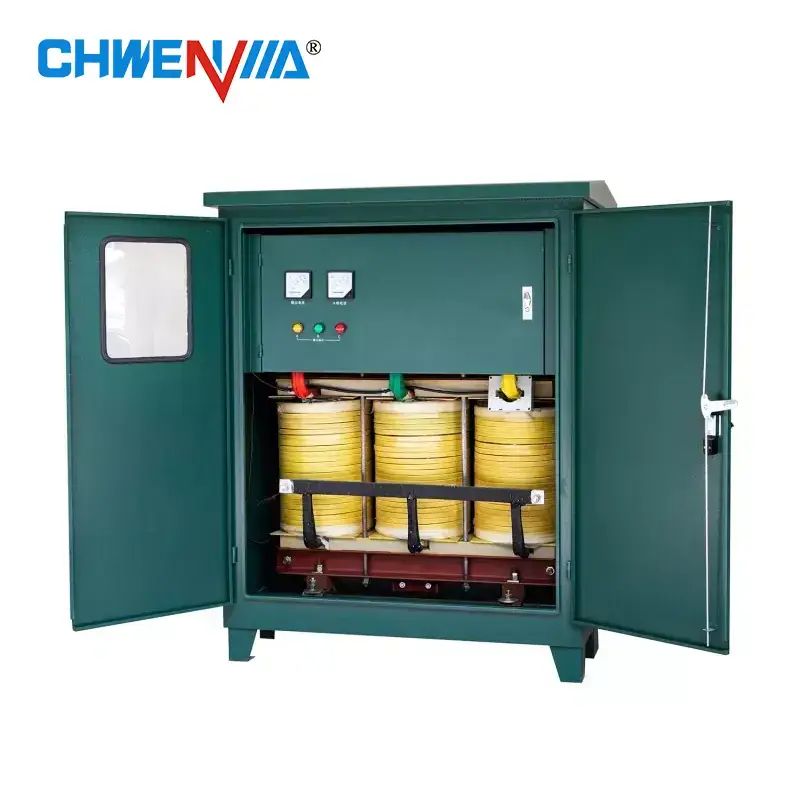
Recent shifts in material science are quietly pushing dry-type transformers past the efficiency ceilings that once defined them. Rather than chasing incremental gains through larger cores or heavier copper windings, engineering teams are now embedding amorphous metal ribbons and nano-crystalline alloys directly into the magnetic circuit. These materials slash no-load losses by up to 70% compared to conventional grain-oriented silicon steel, and they do so without adding bulk. The real breakthrough, however, isn't the alloy itself—it's the investment in precision laser-scribing and stress-relief annealing that allows these brittle ribbons to be wound reliably at production scale. What emerges is a transformer that runs cooler, wastes less energy during idle periods, and fits into the same footprint as older models.
Another area where R&D budgets are reshaping expectations is in thermal management and insulation chemistry. Instead of relying on traditional epoxy resin systems that trap heat, developers are experimenting with hybrid polymer-ceramic coatings that improve thermal conductivity while maintaining dielectric strength. Some pilot lines now use additive manufacturing to print winding supports with internal cooling channels, effectively turning the entire coil assembly into a heat exchanger. These investments target the often-overlooked reality that dry transformers in solar farms, data centers, and metro substations rarely operate at full load. By reducing hot-spot temperatures and flattening the thermal gradient, the new designs extend insulation life and allow higher sustained overloads without derating.
Perhaps the most disruptive R&D push is in embedded sensing and smart derating algorithms. Manufacturers are integrating fiber-optic temperature sensors and partial discharge monitors directly into the cast resin, feeding real-time data to edge controllers that adjust cooling fans or issue predictive maintenance alerts. Unlike the generic "smart grid" marketing language of a decade ago, these systems now rely on physics-informed machine learning models trained on thousands of field installations. The payoff is measurable: one European utility reported a 12% reduction in energy-related losses across its dry transformer fleet within two years of deploying such adaptive monitoring. This convergence of materials innovation, thermal engineering, and embedded intelligence is what actually moves the efficiency needle—not just bigger nameplates or improved test scores under ideal lab conditions.
Which Chinese Transformer Brands Are Winning in Renewable Energy?
China's push into renewables has created a fiercely competitive market for transformers, and a handful of domestic brands are quietly pulling ahead. TBEA, China XD, and Baobian Electric no longer compete solely on price; they've built engineering teams that understand the messy realities of wind farms in the Gobi Desert or floating solar arrays on reservoirs. Their advantage comes from iterating faster than foreign rivals, testing insulation systems against sandstorms and salt spray, and then folding those lessons back into standard product lines. This isn't about matching specs on a datasheet—it's about surviving the first winter without a failure.
Take offshore wind as an example. TBEA has supplied 220kV transformers for platforms in the South China Sea, where corrosion and vibration kill ordinary equipment within years. The company redesigned the tank sealing and cooling loops after field data showed micro-leaks forming at weld joints. Meanwhile, China XD took a different route: instead of chasing the largest capacity ratings, it focused on compact, skid-mounted step-up transformers for distributed PV plants. Those units can be delivered in six weeks and installed by a crew of three, which matters more to developers than a 0.2% efficiency edge. Baobian, on the other hand, has leaned into dry-type transformers for battery storage systems, using cast resin coils that don't mind the frequent thermal cycling of grid-scale batteries.
The next wave won't be won by horsepower alone. Digital monitoring built into the transformer—temperature, partial discharge, tap-changer wear—is becoming a baseline expectation from wind and solar operators who run lean maintenance teams. Chinese brands are embedding these sensors at the factory rather than bolting them on later, a small shift that changes how failure data flows back into design. Regulators are also pushing for ester-based insulating fluids to replace mineral oil near sensitive ecosystems, and local suppliers have moved faster than expected to certify biodegradable options. None of this makes headlines, but it's the kind of unglamorous work that determines which brands survive when subsidies fade and every megawatt-hour has to earn its keep.
How Strict Quality Control Sets These Companies Apart
What really separates market leaders from everyone else isn't just innovation or marketing spend—it's the obsessive attention to quality at every stage. These companies treat QC not as a final checkpoint but as a continuous loop: raw materials are vetted before entering production, in-process measurements flag drift within microns, and finished goods face simulated stress tests far beyond normal use.
That kind of rigor shows up in the details customers rarely see. One manufacturer, for example, rejects a full batch if a single seam measures 0.2 mm outside spec—even though that deviation wouldn't be visible to the naked eye. Another runs every unit through a 72-hour burn-in cycle before packing, pulling any product that flickers once. This isn't about avoiding returns; it's about refusing to let anything but the intended experience leave the floor.
Over time, that discipline compounds into something competitors can't easily copy: reputation. Buyers may not know the exact tolerance thresholds, but they sense the difference—fewer defects, longer lifespans, and that quiet confidence of owning something built without shortcuts. In markets flooded with near-identical options, that perceived reliability becomes the tiebreaker.
The Role of Customization in China's Dry Transformer Success
Customization has quietly become the backbone of China's rise in the dry transformer market. Rather than pushing one-size-fits-all units, leading manufacturers have learned to listen first—mapping out voltage fluctuations, harmonic loads, and even the ambient dust levels of a client's facility before proposing a design. This shift from product-centric to problem-centric thinking means a single factory might ship a compact cast-resin unit for a subway tunnel, a high-impedance variant for a wind farm, and a low-noise model for a hospital, all within the same quarter. It is this willingness to bend the product around real operating conditions, not just tweak a catalog number, that separates Chinese suppliers from competitors still locked into standardized production lines.
The practical impact of such customization shows up in ways that standard specs rarely capture. For instance, a textile plant in Jiangsu dealing with severe voltage sag requested a dry transformer with an oversized core and reinforced winding supports. A data center in Guizhou, where humidity spikes during monsoon season, ordered a unit with enhanced encapsulation and corrosion-resistant terminals. Engineers on the ground adjust insulation classes, add custom tap ranges, or rework cooling ducts to fit cramped electrical rooms. Because much of the design and prototyping happens in-house, turnaround times shrink from months to weeks, and the final unit often costs less than a generic imported alternative that would still require on-site modifications. Customization, in other words, is not a luxury add-on but a cost-control strategy.
What makes this approach sustainable is the tight feedback loop between field performance and design iteration. When a customized unit underperforms or fails, the failure data flows directly back to the design team, not through layers of distributors. That loop allows rapid refinement of material choices, winding geometry, and thermal modeling. Over time, Chinese manufacturers have built a library of application-specific configurations—mining-duty, offshore-wind, rail-transit, semiconductor-fab—each documented and ready to adapt. This accumulated know-how becomes a competitive moat. A new entrant can copy a product, but not the thousands of small adjustments learned from running customized dry transformers in harsh, real-world environments across dozens of industries.
What Overseas Buyers Should Look for in a Chinese Dry Transformer Partner
When vetting a dry transformer manufacturer in China, dig past the glossy brochures and price sheets. Ask for verifiable test data from independent labs, not just in-house certificates. A partner worth your time will openly share thermal cycling results, partial discharge readings, and noise level measurements under load. If they hesitate or only provide marketing speak, keep moving.
Look closely at their material sourcing. The difference between a transformer that lasts twenty years and one that fails in five often comes down to the grade of cold-rolled grain-oriented silicon steel, the quality of epoxy resin, and the precision of winding tension. Tour their facility—virtually if necessary—and ask to see incoming inspection records. Real quality control starts before the first bolt is tightened.
Finally, evaluate their communication rhythm. A strong partner responds to technical questions with specifics, not vague assurances. They assign an engineer, not just a sales rep, to your account. And they don't vanish after the invoice is paid—they offer clear warranty terms, spare parts availability, and a genuine interest in how their equipment performs on your site months after installation.
FAQ
There is a solid group of established manufacturers, including Hainan Jinpan Smart Technology, TBEA, Baoding Tianwei Baobian Electric, Jiangsu Huapeng Transformer, Sanbian Sci-Tech and Shandong Dachi Electric. Each of them has years of experience with cast resin and vacuum pressure impregnation designs.
Jinpan put dry type transformers at the center of its business early on, rather than treating them as a side line. Its products show up in data centers, wind farms and industrial parks across Asia and Europe, and the company has a strong track record with international certifications like UL and KEMA.
Most of them go into commercial buildings, hospitals, airports, metro systems, solar farms and offshore platforms. The main reason is that dry type units don't use oil as a coolant, so fire safety is better and maintenance work is much simpler in tight indoor spaces.
Yes, many top-tier Chinese manufacturers design for tropical humidity, high altitude and coastal salt spray. Export models are often tested to IEC standards and can include special coatings, anti-vibration mounting and wider temperature operating ranges.
Typical products cover 0.4 kV to 40.5 kV on the medium-voltage side, with capacities from about 10 kVA up to 25 MVA for special large units. Forced air cooling systems can raise the rated capacity by 40% or more depending on the design.
Look beyond the price. Request factory test reports for partial discharge, temperature rise and short-circuit withstand. Ask about reference projects in your region and whether the company offers local after-sales support or spare parts within a reasonable lead time.
Many of them use automated foil winding, vacuum casting under controlled humidity, and computer-controlled curing ovens. This leads to low partial discharge levels, strong mechanical strength during short circuits, and consistent insulation quality from batch to batch.
Conclusion
China's dry type transformer sector has grown far beyond simple cost advantages, evolving into a network of manufacturers that combine heavy production capacity with sharp technical focus. The companies leading this space operate large-scale facilities where automated winding, vacuum casting, and precision core cutting happen under one roof, allowing them to turn out thousands of units monthly without sacrificing consistency. At the same time, their R&D teams are pushing efficiency gains through better magnetic materials, lower-loss cores, and smarter thermal management, which means modern dry transformers from these brands often outlast older oil-filled designs in demanding environments. When you look at renewable energy projects across Asia, Africa, and Latin America, a handful of Chinese names keep appearing, not just because they bid aggressively, but because their products handle frequent load swings and harsh grid conditions with fewer failures.
What really separates the top ten from the hundreds of smaller workshops is an almost obsessive approach to process control. Incoming silicon steel, copper wire, and epoxy resin are tested batch by batch, while finished units undergo partial discharge, impulse, and temperature-rise checks before shipping. Customization also plays a huge role: buyers can request non-standard voltages, unusual enclosure ratings, or specific noise limits, and these companies respond with engineering support rather than catalog excuses. For overseas buyers, the smart move is to ignore flashy websites and instead verify factory audit reports, third-party test certificates, and actual project references in their target region. A reliable partner will openly share failure rate data and warranty claim histories, while a weak one hides behind marketing language. The strongest Chinese dry transformer makers have learned that long-term export success depends on transparent quality data, responsive after-sales support, and the willingness to co-develop solutions for local grid codes and climate conditions.
Contact Us
Contact Person: Mr. Jiang
Email: [email protected]
Tel/WhatsApp: +86-15057775503
Website: https://www.avrfactory.com/