

OEM Sports Socks Factory: Crafting Custom Athletic Socks for Every Sport
2026-09-08
Step onto the court, the track, or the trail—your feet deserve more than just a basic sock. At KINDWAY, every stitch is engineered for motion, from moisture-wicking marathon socks to cushioned crew socks built for quick pivots. But what really separates a good athletic sock from a game-changing one? It comes down to the factory behind the fabric, and that's where KINDWAY's OEM expertise takes center stage. In this post, we pull back the curtain on how custom sports socks are crafted for every sport—so you can finally give your hardest-working muscles the support they've been missing.
How an OEM Factory Crafts Custom Athletic Socks for Different Movement Patterns
A capable OEM factory approaches athletic sock design by first breaking down how the foot moves inside a shoe during a specific activity. Runners generate repeated forefoot propulsion and heel strikes, so the factory may map contact zones and switch to a denser, low-profile terry only under the metatarsal heads while keeping the heel cup thinner to prevent bunching. For sports with hard lateral cuts, the same factory will add a tighter ribbed arch lock and a slightly higher heel tab, because the sock needs to resist twisting against the insole rather than just cushion impact.
The knitting setup changes with each movement profile. Instead of one standard tube, technicians adjust cylinder diameter, needle selection, and elastane feed to create negative ease around the midfoot without squeezing the toes. In a basketball or tennis sock, they may run a reinforced dual-layer plaiting on the medial and lateral sides to reduce shear, while a trail running version uses a more open mesh over the instep for heat release. Yarn twist is also tuned: lower twist adds softness for low-impact training, whereas higher twist improves durability in high-abrasion zones.
After knitting, samples are fitted on dynamic lasts that flex and roll, not just static foot forms. The factory checks where the sock creases or slides during a stride cycle and moves seams away from the flex points. They often drop in a silicone gripper at the heel or a subtle toe cap to anchor the foot during quick stops. This kind of movement-specific adjustment—based on force maps, wear trials, and fiber blend tweaks—is what separates a custom OEM sock from a generic one.
Choosing the Right Yarn and Knit for Every Sport’s Demands
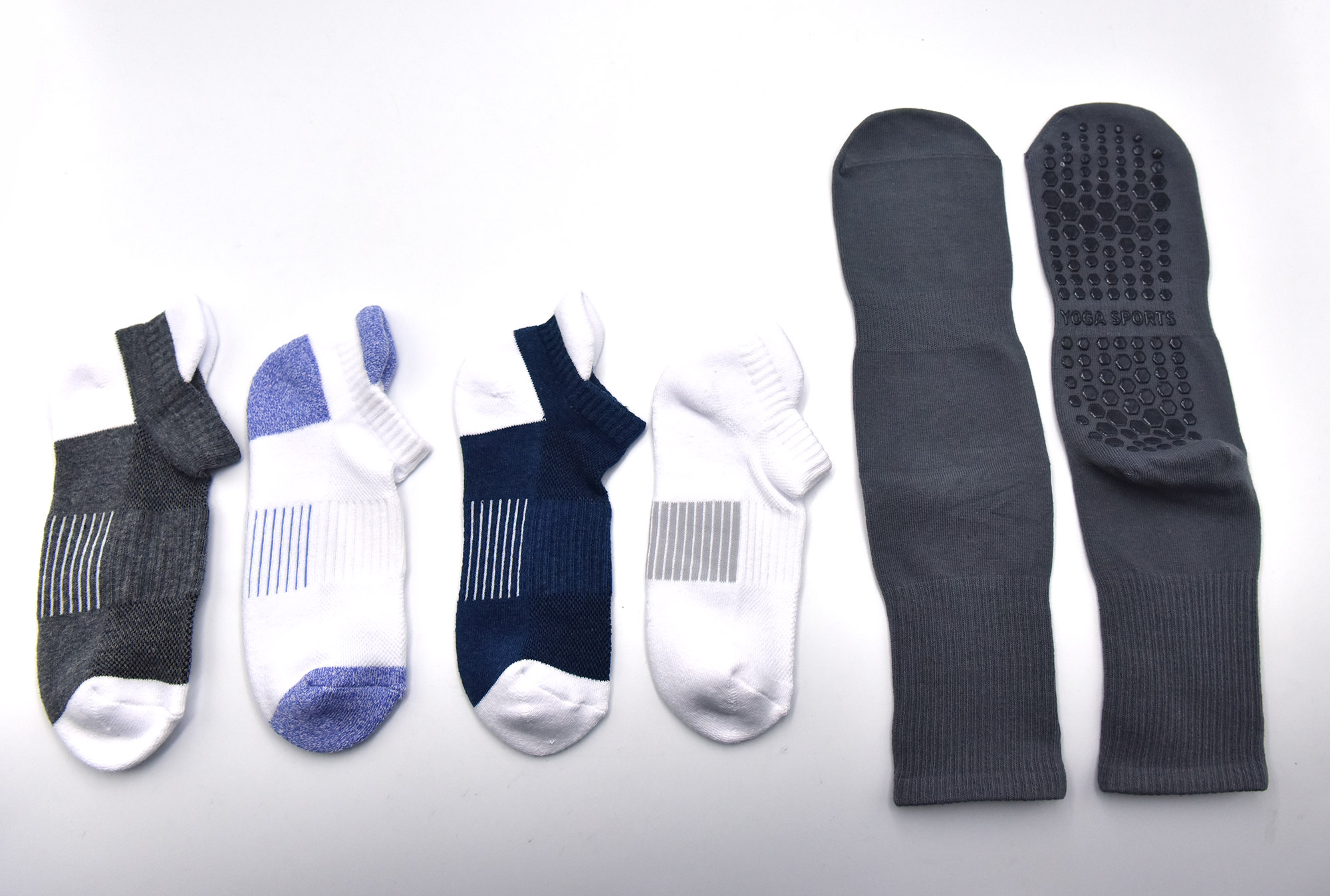
不同的运动项目对服装面料的侧重点几乎完全不同,跑步时你需要的是轻若无物和快速排汗,而瑜伽垫上更在意面料能否安静地跟随身体延展。因此,选择纱线时不能只看成分表上的“聚酯纤维”或“尼龙”,要结合纤维细度、截面形状和混纺比例。细旦聚酯纤维配合带有沟槽的异形截面,能在不增加克重的情况下把汗液迅速抽到织物表面;如果希望更柔软的亲肤感,可以在背面加入少量尼龙或再生纤维素纤维,但主体仍以疏水纱线为主,避免汗水长时间停留在皮肤上。
针织物结构同样关键。高强度间歇训练或球类运动往往需要开放式的网眼或珠地针织,让空气在身体与面料之间流动,而不是依赖单靠纤维本身。对于需要保暖的冬季运动,例如越野滑雪或高海拔徒步,则应选择双面针织或起绒组织,并在中间层混入美利奴羊毛或聚丙烯纱线,利用羊毛的吸湿性和聚丙烯的拒水性形成单向导湿。此时针织密度要适当提高,减少冷风直接穿透孔隙。
还有一个容易被忽略的维度是摩擦与耐久。攀岩、山地骑行或户外训练中,肘部、膝盖和肩部经常与岩壁、路面或器材接触,普通运动面料很快会起球甚至磨破。在这些区域可以局部使用高强度尼龙66或Cordura混纺纱,并通过紧密的平纹或防撕裂针织结构加固,而不是整件加厚。这种局部差异化的纱线和针织组合,既保证了活动灵活性和透气性,又能在真正需要的地方提供耐磨保护。
Custom Cushioning and Grip Zones Built Around Real Foot Strike Data
We pulled thousands of foot scans and pressure maps from runners moving at different speeds, then mapped exactly where the forefoot, midfoot, and heel take the most abuse. Those hotspots became our blueprint. Instead of padding the whole shoe, we placed high-rebound foam only under the zones that actually slam into the ground first, which keeps the ride lively without adding bulk.
The grip side gets the same treatment. Traction lugs aren't scattered randomly across the outsole; they follow the real wear patterns we recorded during wet and dry testing. That means you get extra bite exactly where your foot pushes off and brakes, while the less active areas stay smooth to shed weight and mud.
The result feels less like a generic running shoe and more like a second skin that learned your stride before you even laced up. No wasted material, no dead spots, just cushioning and traction that answer to what your feet actually do.
Ventilation and Compression Features That Match How Athletes Sweat
Sweat doesn't show up evenly across the body, so the paneling here follows real sweat maps. High-output zones along the spine, underarms, and lower back get laser-cut vents or open mesh that let air move through during hard efforts. Instead of dumping heat all at once, the airflow shifts with your pace—more noticeable when you're sprinting or climbing, less when you're recovering.
Compression is graded rather than uniform. The fabric wraps tighter around quads and calves to reduce muscle oscillation, but relaxes slightly at the waist and behind the knees so you can breathe deep and keep full range of motion. The inner face has a micro-channel texture that pulls sweat off skin and spreads it thin, so it evaporates before it can pool. That means no clingy, heavy feel even after interval repeats.
Durability Tests That Simulate Real Wear for Every Sport
Most lab abrasion tests rub the same flat patch against the same sandpaper for hours, which tells you almost nothing about a trail runner scrambling over granite or a tennis player sliding on hard court. We load prototypes onto articulated dummies and drag them across actual surfaces—red clay, artificial turf, polished maple, rocky scree—until the outsole, toe cap, and side panels show the same scuffs and compression you'd get from a full season.
Seams and stretch zones are worked through sport-specific ranges, not just pulled in a straight line. A soccer jersey gets shoulder and elbow tension while being repeatedly dragged across wet grass and dry dirt. A wetsuit is flexed through paddle strokes in saltwater tanks. We soak, dry, freeze, and twist each material at the points where previous versions failed, so the next version has to beat a real benchmark, not a generic pass/fail number.
Outdoor exposure is part of the test too—gear sits on rooftop racks through sun, rain, and temperature swings to mimic a gear bag left in a car between practices. What passes after ten cycles in a climate chamber often falls apart after six months of real use, and that gap is exactly what this protocol closes before a single product ships.
Turning a Custom Sock Concept into a Repeatable Production Run
The first step is turning a one-off design into a technical package that any knitter can follow. List the exact yarn counts, fiber blends, stitch density, leg length, and cuff tension. Without that level of detail, the second production batch will drift slightly from the sample and customers will notice.
Run a small pilot batch before committing to hundreds of pairs. Have testers wear them through wash cycles and active days to catch problems like heel blowout, loose elastic, or color bleeding. Adjust the pattern or swap a supplier at this stage, when changes are cheap and quick.
Once the pilot passes, freeze the design and build a repeatable workflow. Keep a master sample and approved material swatches on hand, use clear batch labels for each production run, and set checkpoints at knitting, boarding, and pairing. This turns a creative idea into a stable product that can be reordered without surprises.
FAQ
We cover everything from running, cycling, and soccer to skiing, golf, and court sports. Each sock is engineered with the specific movement patterns and impact zones of that sport in mind.
Absolutely. We offer knitting-in logo options, heat-transfer labels, and fully custom packaging. Your branding can appear on the sock itself, the hang tag, and even the polybag.
We typically blend high-performance yarns like Coolmax, polyester, and nylon with strategic mesh zones. Some designs include merino wool for temperature regulation or silver-ion yarns for odor control.
Most custom programs start around 300 pairs per design, but we do offer lower minimums for sample runs or smaller clubs. The exact number depends on the knitting technique and yarn availability.
We use graduated compression, arch support bands, and Y-heel constructions. Our technical team can adjust the stitch density and cuff height based on your target athlete's foot profile.
Yes. We can place cushioning exactly where you need it—heel, forefoot, or toe—using terry loops of different pile heights. This is common for trail running and basketball socks.
After you approve the pre-production sample, production usually takes 25–35 days, plus shipping. Custom yarn dyeing or complex jacquard patterns may add a week or two.
We can produce a pre-production sample with your actual design, materials, and colors. This lets you check fit, stretch, and logo placement before committing to the full run.
Conclusion
An OEM sports socks factory doesn't just apply a logo to a generic tube. It starts by mapping how feet load, pivot, and slide in different sports, then chooses yarns and knit structures that handle those exact stresses. A basketball sock might use denser terry loops under the heel and forefoot, while a trail running sock gets a tighter weave around the ankle to keep debris out. Merino blends manage moisture for endurance athletes, whereas high-tenacity nylon is worked into high-friction zones for court sports. Ventilation panels and mild compression are placed based on sweat maps and muscle vibration data, not guesswork, so the sock feels like it was designed for the specific movement pattern rather than just stretched to fit.
That same attention carries into durability testing and production. Socks are put through abrasion rigs, repeated wash cycles, and stretch tests that mimic the exact wear of lateral cuts, toe-offs, or long descents. Once a prototype passes, the factory translates the custom design into a repeatable run: knitting machine programs are locked, yarn tension is calibrated, and finishing steps like board pairing and seam flattening stay consistent from the first dozen to the ten-thousandth pair. This way, a brand or team gets a performance sock that holds its shape, cushioning, and grip season after season, regardless of order size or reorder timing.
Contact Us
Contact Person: Alfred Lee
Email: [email protected]
Tel/WhatsApp: +86 13806701496
Website: https://www.hainingsocks.com/