
China Cryogenic Ball Valve Manufacturer Selection Guide for Critical Low-Temperature Service
2026-10-04
When temperatures plummet, ordinary ball valves can turn brittle—and dangerous. Selecting the right cryogenic ball valve manufacturer in China isn't just about specs; it's about survival of your process. From LNG terminals to cold boxes, each choice carries risk. ZMV has spent years refining low-temperature sealing and extended bonnet designs, but how do you separate proven performance from marketing noise? This guide cuts through the confusion.
Why Most Cryogenic Ball Valves Fail Before They Reach the Field
Cryogenic ball valves often carry impressive spec sheets, yet plenty of them never survive the journey from the factory floor to an actual LNG line. The usual culprit isn't a single dramatic flaw but a cascade of small oversights that only show up when temperatures plunge. For instance, seats made from standard PTFE can shrink and lose interference at -196°C, while fasteners torqued at room temperature loosen as the body contracts. What passes a hydrostatic test in a warm warehouse can leak badly once the valve is chilled with liquid nitrogen.
Another frequent failure point happens before the valve is even bolted into place. Moisture trapped inside the ball cavity or stem packing freezes solid when the valve is first cooled, jamming the mechanism or cracking thin sections. Some manufacturers skip proper cryogenic cleaning because it adds time and cost, relying instead on a quick solvent rinse that leaves behind machining oils or cutting debris. Those residues harden into abrasive particles that score the ball and seats during the first few cycles under cold conditions.
Finally, handling and shipping damage gets underestimated. A valve that withstands a 600 psi shop test can be bounced across a rough road or lifted by the actuator instead of the body, distorting alignment just enough to cause internal leaks. Add in insufficient inspection after transportation—many valves are installed straight from the crate—and you have a product that looks flawless on paper but fails at commissioning, long before it ever sees actual service.
The Material Traceability Trap in Low-Temperature Valve Supply
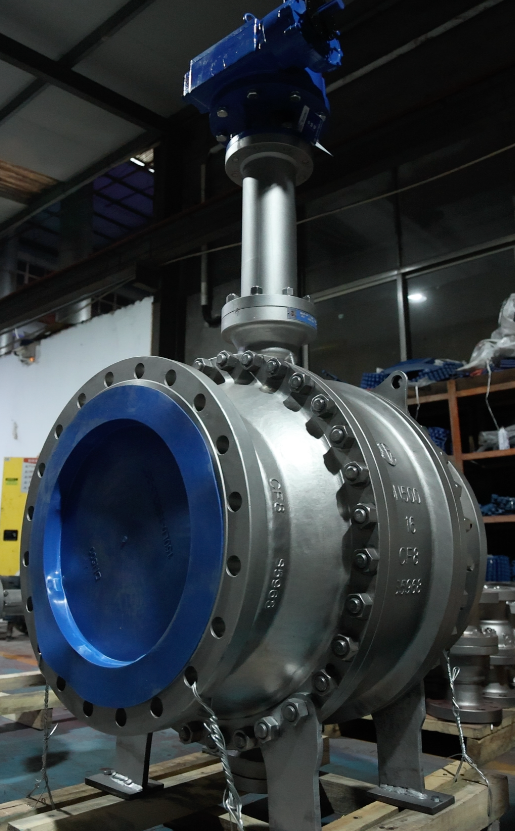
Low-temperature valve procurement often treats material certificates as the final proof of traceability, but the paper trail can be misleading. A supplier may provide an EN 10204 3.1 certificate with heat numbers, chemical composition, and mechanical properties that all look correct, yet the physical link between those documents and the actual valve body is frequently broken. For example, heat numbers on castings can be ground off and restamped, or one delivery batch may contain components from several different melts while only a few heat numbers appear on the certificate. This becomes critical in cryogenic service because a non-low-temperature grade material can lose ductility at -196 degrees Celsius and fail without warning.
Another common trap appears in multi-tier supply chains. A valve manufacturer buys raw forgings or castings, machines and assembles them, then ships through a trader or integrator before they reach the end user. At each handoff, the original material identity can be simplified, copied incorrectly, or simply omitted. The final user may see a material designation on paper but has no way to confirm that it matches the metal actually installed. Unscrupulous suppliers know this weakness and sometimes substitute cheaper non-cryogenic material because normal visual checks and dimensional inspections cannot reveal the difference.
Avoiding this trap requires more than trusting the documents provided. Experienced buyers add positive material identification testing at receiving or final inspection, run optical emission spectroscopy on pressure-containing parts, and randomly select samples for low-temperature impact testing. They also insist that every valve keeps a permanent marking tied to the original heat number through all manufacturing stages. If these verification steps are skipped, material traceability remains only a promise on paper rather than a real safeguard for low-temperature service.
Pressure Testing That Actually Mimics LNG and Liquid Oxygen Duty
Most pressure tests fall short because they treat cryogenic fluids like warm water. Real LNG and liquid oxygen bring thermal shock, phase change, and material contraction that standard hydrostatic procedures never capture. A meaningful test has to cycle the system through chilled conditions, hold pressure while the metal shrinks, and then watch for micro-leaks at joints that only open up at negative 160 degrees Celsius or lower.
The trick is to avoid over-testing with a single static pressure spike. Instead, we ramp pressure gradually while the vessel sits in a chilled bath or gets cooled by controlled boil-off gas. This lets flanges, valve seats, and weld seams move the way they will in actual service. Some facilities even alternate between liquid nitrogen and liquefied natural gas simulants to match thermal conductivity and viscosity more closely.
The payoff shows up months later, when a system that survived a realistic cryogenic pressure profile doesn't surprise you with a brittle fracture or a weeping seal on its first cold start. It costs more and takes longer than a standard hydro test, but for anything handling LNG or LOX, that's the only kind of pressure testing worth doing.
Seat and Seal Design: Where Leak Paths Hide at -196°C
At -196°C, metals shrink, polymers lose their resilience, and the once-tight interface between seat and ball or plug opens microscopic channels. Leak paths rarely announce themselves with obvious gaps; they hide in the relaxation of retained stress after thermal cycling, in the uneven contraction of seat rings relative to their metal retainers, and in the loss of elasticity that normally keeps soft seals pressed against the sealing surface.
A commonly overlooked path runs behind the seat pocket. The seat may be energized by a spring or a lip, but at cryogenic temperatures that stored energy can fade as the spring loses force and the seat takes on a compression set. If the retainer's coefficient of thermal expansion does not match the seat material, the clearance behind the seat becomes a bypass route, even when the main sealing face still looks intact under a borescope.
Closing these paths means treating the seat and its pocket as a system rather than a static seal. That requires matching CTE curves across the full cooldown range, using seat geometries that flex instead of crush, and verifying closure under real thermal gradients rather than room-temperature bench tests. At -196°C, a leak is often the signature of a design that works on paper but forgets that the cold shortens every part by a slightly different amount.
Vetting Chinese Manufacturers Beyond Certificates and Trade Shows
Certificates and trade show booths create a false sense of security. A factory can rent a polished booth, display perfect samples, and hand out ISO certificates that were either purchased or borrowed from a cousin's operation. Meanwhile the actual production line may run at half capacity with untrained workers and substandard raw materials. The gap between the showroom and the shop floor is often wider than any audit report suggests.
What actually works is showing up unannounced. Walk the floor, ask operators about their shift patterns, look at the maintenance logs, check whether the equipment matches the capacity claims on paper. Ask to see recent shipment records and then call a few of those buyers directly. If a factory hesitates to let you speak to their current customers or refuses a same-day visit, treat that as a red flag bigger than any missing certificate.
Local fixers and third-party inspectors can help, but only if they aren't on the factory's payroll. Some agents will take a commission from both sides and then write glowing reports. Vet the vetter: check their references, ask for raw photos with timestamps, and rotate inspectors so no one gets too comfortable. The goal isn't to collect documents; it's to understand what happens when nobody is watching.
Lifecycle Economics: The Cost of a Cryogenic Valve Is Not on the Invoice
The purchase price of a cryogenic valve rarely reflects what it will actually cost over twenty years of service. Buyers tend to compare quotes line by line, but the real financial burden accumulates later: unplanned downtime, nitrogen losses from seat leakage, repeated rework during turnarounds, and the labour hours spent chasing performance issues. A valve that saves a few thousand dollars upfront can quietly consume ten times that amount through reduced process availability and higher maintenance frequency.
Low-quality cryogenic valves often fail in ways that don't show up in a standard bid tabulation. Extended bonnet designs that frost inconsistently, stem seals that harden after repeated thermal cycling, or trim materials that gall at low temperatures all create hidden operating costs. Each repair requires specialised handling, often under tight plant shutdown windows, and every hour of lost production shifts the economics further away from the original invoice figure.
A more realistic evaluation weighs procurement cost against predictable performance over the asset's life. This means looking at actual leakage rates under thermal stress, mean time between repairs, local service support, and the cost of keeping spare parts on the shelf. When those factors are included, the cheapest valve on paper is rarely the cheapest valve in operation. The invoice is just the opening line of a much longer cost story.
FAQ
For LNG duty, the body and ball are usually cast or forged 316L stainless steel (CF3M or F316L) because austenitic stainless retains toughness down to cryogenic temperatures. Stems often use 316 or 17-4 PH with appropriate heat treatment, while seats typically use PCTFE or a metal-seated design if abrasive particles are present. Avoid carbon steel components below the extended bonnet unless they are specifically low-temperature grades like LCB or LCC, and even then their use is limited to less severe services.
The extended bonnet creates a thermal gradient between the cold fluid and the packing area. By lengthening the distance, the packing gland and stem seals stay close to ambient temperature, which prevents ice formation that can lock the stem or damage seals. It also leaves room for insulation and keeps the actuator mounting flange from frosting over, so the operator or actuator can function normally.
Look for compliance with BS 6364 or ISO 28921-1. These standards require cooling the valve to the minimum design temperature, then performing shell and seat leak tests with helium while the valve is cold. A reputable Chinese manufacturer will also run a thermal cycling test and a full open-close cycling sequence under cryogenic conditions, not just a single static leak check.
Trunnion-mounted balls are supported at both top and bottom, so line pressure pushing on the ball is transferred to the bearings instead of the downstream seat. This reduces operating torque, prevents seat deformation under high pressure, and maintains tight shutoff even with large bore sizes or high differential pressures. Floating ball valves can work in small sizes, but they put higher load on the seats and are more sensitive to thermal contraction, which can cause leakage in cryogenic applications.
At minimum, request material test reports per EN 10204 3.1, pressure test certificates, and cryogenic test reports. The manufacturer should hold ISO 9001 and preferably API 6D for pipeline valves, API 607 or 6FA for fire-safe approval, and PED or ATEX if the valve will be installed in the EU or in hazardous areas. A documented welding procedure and NDE personnel qualifications are also worth reviewing for critical applications.
PCTFE (polychlorotrifluoroethylene) is the dominant soft seat material because it maintains dimensional stability and low friction at cryogenic temperatures, unlike PTFE which can cold-flow. Metal seats, often with tungsten carbide or chrome carbide coatings, are used when the fluid contains solids or when high cycle life is required. For cavity relief, look for a self-relieving seat design or an external pressure relief device in the body cavity, since trapped liquid can expand dramatically when warmed and rupture the valve.
Ask for dimensional inspection reports on critical features like ball roundness, seat pocket depth, and stem-to-ball alignment. Check whether the manufacturer performs cryogenic treatment or stabilization of raw castings before final machining, because residual stress can cause distortion at low temperature. A factory tour or video audit showing clean assembly areas, calibrated torque tools, and helium mass spectrometer leak testing stations is a strong positive signal.
Custom extended bonnet lengths, non-standard flange ratings, or specific actuator interfaces can add two to four weeks to normal lead times. You should plan for six to twelve weeks as a realistic window for engineered cryogenic ball valves, depending on size and testing requirements. If you need witnessed cryogenic testing or third-party inspection, add another week for scheduling. Avoid suppliers that promise extremely short deliveries for custom low-temperature valves, because rushed production often skips thermal cycling or documentation steps.
Conclusion
Far too many cryogenic ball valves never make it past first installation because buyers focus on price and delivery while ignoring the failure modes that emerge only at -196°C. A proper China sourcing strategy starts with demanding full material traceability—not just an ISO certificate, but heat-level documentation for every body, ball, and stem component, cross-checked against independent PMI testing. The pressure test is another place where shortcuts hide: a standard hydro test at room temperature says almost nothing about how the valve behaves when the seat shrinks and the lubricant turns brittle under liquid oxygen or LNG. Insist on cryogenic testing with actual media or at least a controlled cool-down cycle that tracks seat leakage and stem torque throughout the thermal contraction. Seat and seal design is where leak paths quietly multiply—look for one-piece seat pocket geometries that avoid trapped cavities, and ask how the manufacturer validates sealing after repeated thermal cycles, not just a single cold soak.
Vetting Chinese manufacturers means going beyond polished trade show booths and stacked certificate binders. Visit the factory floor unannounced if possible, or at least audit the heat treatment, machining, and assembly areas yourself. Check whether the welding procedures and NDE personnel are actually in-house or subcontracted. Then shift the conversation to lifecycle economics: a valve that costs 30% less upfront but fails a seat leak test during commissioning or needs replacement after eighteen months is far more expensive than the invoice suggests. Factor in downtime, purge gas losses, and the true cost of re-qualifying a new supplier. The right Chinese cryogenic valve partner is not the one with the lowest quote, but the one who can walk you through their failure history, test deviations, and material substitution policy without flinching—and who treats every low-temperature application as a unique engineering problem rather than a commodity order.
Contact Us
Contact Person: Lucas Lin
Email: [email protected]
Tel/WhatsApp: +8613968913000 / +8613868610141
Website: https://www.zhengmaogroup.com